Skip to content Skip to footer

The Roast Potato Party: Calling from a Smouldering Ground: Pritam Das

Discover An Author

  • Pritam Das (b. 1996) is a multidisciplinary artist based between Singur and Santiniketan. He holds an MFA in Painting from Kala Bhavana, Visva Bharati University (2022). His practice investigates Singur’s socio-political and ecological realities, shaped by forced industrialization and land movement aftershocks. He re-translates oral histories, archives, and memory through a reconstructive methodology involving site-responsive installations, drawings, videos, and material explorations to reveal human-land relationships within post-movement, post-truth landscapes. Since 2024, his independent projects include The Roast Potato Party, Shelf Life, and Alter Restaurant. Between 2022 and 2026, his work was displayed at Harvard University, Serendipity Arts Festival, Art Mumbai, Dhoomimal Gallery, Students' Biennale, and Lalit Kala Akademi. He participated in a residency organized by Goethe-Institut, Raqs Media Collective, and Saagwala. Awards include the 2026 Inlaks Fine Art Award and 2019 Camlin Zonal Award. He was featured in the February 2026 issue of Art India Magazine.

    प्रीतम दास (जन्म १९९६) हे सिंगूर आणि शांतिनिकेतन येथे कार्यरत असलेले बहुआयामी कलाकार आहेत. त्यांनी २०२२ साली विश्वभारती विद्यापीठाच्या कलाभवनमधून चित्रकलेत एम.एफ.ए. ही पदवी मिळवली. त्यांच्या कलाकृतींमध्ये सिंगूरमधील सामाजिक, राजकीय आणि पर्यावरणीय वास्तवाचा शोध घेतला जातो — असे वास्तव, जे सक्तीच्या औद्योगिकीकरणामुळे आणि जमीन-आंदोलनानंतर निर्माण झालेल्या परिणामांमुळे घडले आहे. मौखिक इतिहास, संग्रहित नोंदी आणि स्मृती ह्यांना ते नव्याने उलगडण्याचा प्रयत्न करतात. ह्यासाठी ते पुनर्रचना करणारी कार्यपद्धती वापरतात. त्यात जागेशी संवाद साधणारी मांडणशिल्पे (इन्स्टॉलेशन्स), रेखाटने, चित्रफिती (व्हिडिओ) आणि विविध माध्यमांतील प्रयोग ह्यांचा समावेश असतो. ह्या माध्यमांतून आंदोलनानंतरच्या आणि ‘सत्योत्तर (पोस्ट-ट्रुथ)’ वास्तवातल्या माणूस आणि जमीन ह्यांच्या नात्याचा वेध घेण्याचा त्यांचा प्रयत्न असतो. २०२४पासूनच्या त्यांच्या स्वतंत्र प्रकल्पांमध्ये द रोस्ट पोटॅटो पार्टी, शेल्फ लाइफ आणि अल्टर रेस्टॉरंट  ह्यांचा समावेश आहे. २०२२ ते २०२६दरम्यान त्यांच्या कलाकृती हार्वर्ड युनिव्हर्सिटी, सेरेंडिपिटी आर्ट्स फेस्टिव्हल, आर्ट मुंबई, धूमीमल गॅलरी, स्टुडंट्स बिएनाले आणि ललित कला अकादमी येथे प्रदर्शित झाल्या आहेत. त्यांनी गोएथे-इन्स्टिट्यूट, रॅक्स मीडिया कलेक्टिव्ह आणि सागवाला ह्यांनी आयोजित केलेल्या रेसिडेन्सीमध्येही सहभाग घेतला होता. त्यांना २०२६ सालचा इनलॅक्स फाइन आर्ट पुरस्कार आणि २०१९ सालचा कॅम्लिन झोनल पुरस्कार मिळाला आहे. फेब्रुवारी २०२६मध्ये आर्ट इंडिया  ह्या मासिकात त्यांच्याविषयी लेख प्रकाशित झाला होता.

The Roast Potato Party

‘The Roast Potato Party’ did not want to summon people. This was never an  invitation, either. Primarily conceived as a research work presentation, this installation and a potato roasting event as an activation of the work were set to happen on the potato fields near  Beraberi Purba Para village in Singur. There was no formal announcement in the form of  flyers, posters, banners, or miking to the neighbourhoods to join in. Yet, in a landscape where land is a living document of the land movement history of Singur, the act of ‘event making’  became its own loud, irrefragable call.

The Material Call:

In the horizontal expanse of the farmland, every vertical intervention can become a  signal, an effectual visual hook. As the bamboo structure for the harvest residue-filled, fence-like form was gradually taking its shape in the morning light, passing farmers paused, seeing this; stared, and asked questions. While imagining a new meaning of making it, some even  asked if this was  going to be a cultural function or something. They suggested—“Alupora  (Bengali for ‘roast potatoes’)? You are making this for Alupora? You people are mad. If it is necessary to do, do this grandly; bring a  sound box and a spotlight too.” Other concerns were raised, like  “When is it going to happen?” and “What will happen to this structure when it is done?” 

This physical interrogation was the first layer of the invitation. Singur since the last  two decades had been encountering fences, which signalled exclusion and industrial shift; this bamboo skeleton called forth a defensive curiosity. Through these interrogations, the structure  was already inviting respondents to translate it into their own terms, refusing to be a standalone installation.

This structure reversed the logic of an enclosure in a landscape long disfigured by fenced enclosures. The land here reshapes its boundary, demolishing the interpretation of the linear narrative.

The Olfactory Signal:

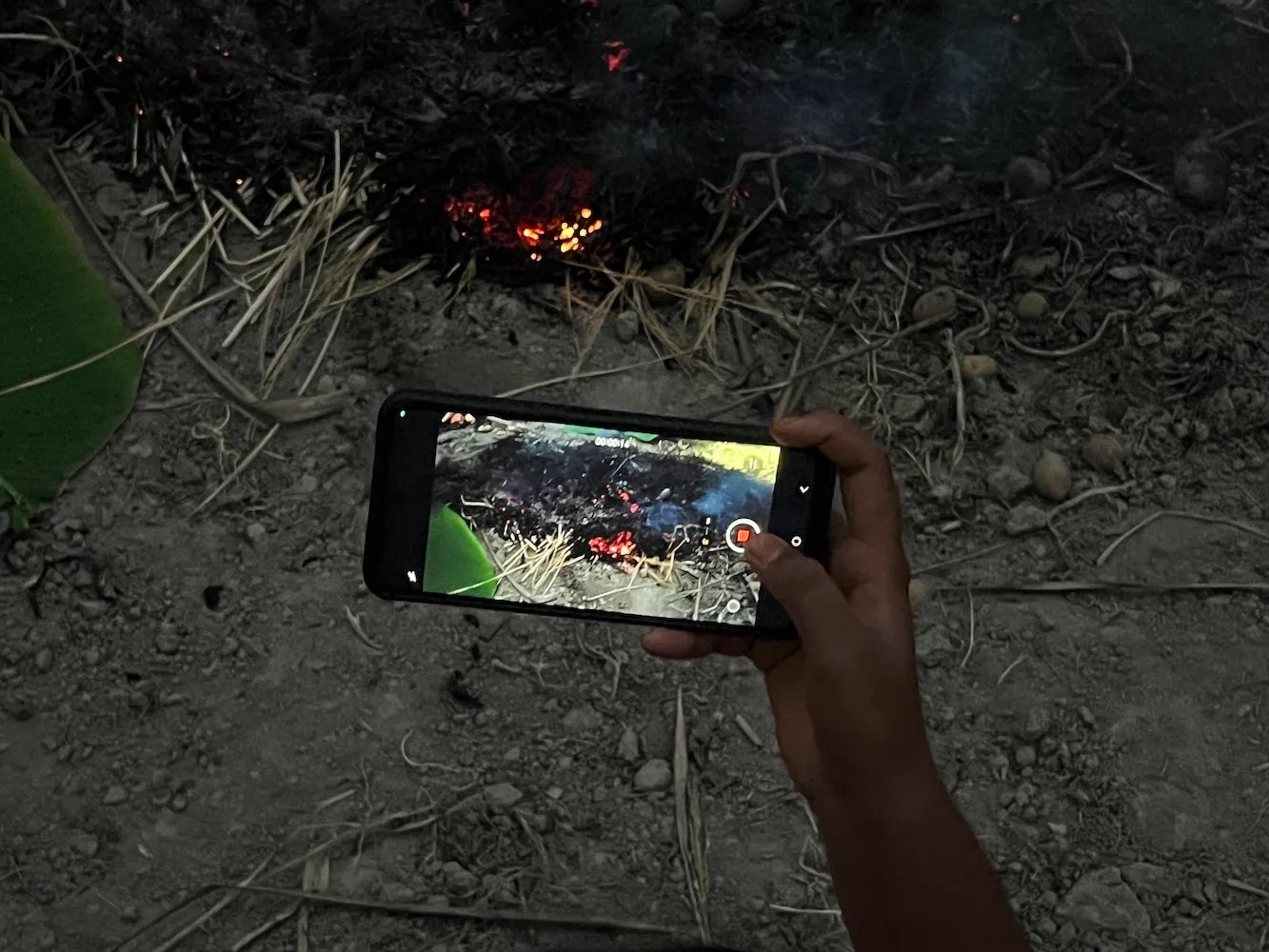
By afternoon, the call was shifting from the visual to the sensory. The fire was lit. The  white, dragonish smoke was announcing that something was happening here, come join us. The smell of roasting potatoes was drawing in more and more curious people. They were not ‘audience’ anymore in institutional frameworks, rather respondents to a sensory flare. They activated a conversation that the space was already having with itself, smouldering since  2006, the beginning of the Singur Land Movement.

Dents in the ‘Great narrative’:

That temporary one-day assembly, surrounded by the fence installation, having 13  fragments of parallel land struggle history across India, has been answered by a multitude of  truths. For participant Niranjan Manna, the fire recalled memories of protest days in Singur; for some young participants, it resembled their childhood memory of Alupora as they were born between 2006-2016 and never witnessed the protests. 

This event approach engages with Gayatri Chakravorty Spivak’s assertion that every  ‘Great Narrative’ is inherently biased and exclusionary, as the act of constructing a unified  story necessitates that something is “left out”. The individual reactions were distinct from  each other. They were fragments of chitchat, remembering, listening, and describing, while  some were busy making vlogs as well. Together, these fragments are reconstructing a larger,  holistic image of multilayered truth.

The news media framed the Singur Land Movement as an industry versus farmer battle. Reporters often only interviewed protesters having similar political views. Even if a report reflected contradictions, there were concluding statements that flattened the spectrum of many thoughts. These silenced voices were asking: “What is the truth?” Undeniably there are uneven versions of the truth from the perspectives of protesters, supporters of industry, or ambivalent landless farmers. The left-out stories were anticipating a community gathering call to own it together and to share what media has not projected yet. The preset linear narrative, as understood through Spivak’s critique of the ‘Great narrative’, collapsed here with this event. In front of this impromptu public engagement, a newer form of collective truth emerged louder than ever.

The Roast Potato Party proved that a gathering call does not need a megaphone.

Reclaim:

The installation has been dismantled once by the rain at night, and also by the participants the next day. The work continues through the fragments of the activities. The community reclaimed the space  through the installation and the roasting event. This was not based on any request, dictation, or design but rather a spontaneous political stance, which creates a biased, fragmented, yet reconstructive ground of togetherness. 

This text emerges from conversations and shared reflections with:

Sourav Manna, Bappa Manna, Soukat Manna, Tista Sarkar, Moumita Barik, Minati Manna, Subhankar Manna, Dipankar Manna, Bapan Manna, Niranjan Manna, Kakali Manna, Saikat Dutta, Srijita Dutta, Tumpa Dutta, Soukriti Manna, Sumitra Manna, Samrat Manna, Ahana Manna, Amita Manna, Manasi Das, Dustu Manna, Kakali Manna, Riksmita Manna, Debarpan Manna, Debajit Manna, Rik Manna.

Reference

Philosophy Overdose. (1984). Debate on postmodernism

Post Tags

Leave a comment