Skip to content Skip to footer

Of Wires and Tenderness: A Coming of Age: Sneha Biswas

Discover An Author

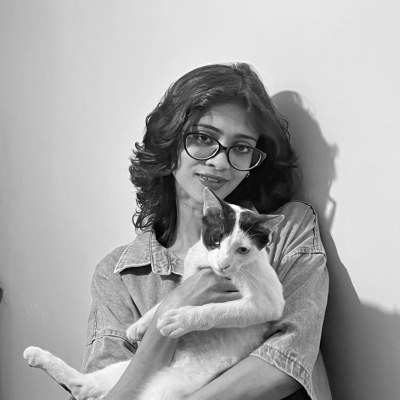
  • Sneha Biswas is an art practitioner and researcher with a background in Art History and English literature. She spends most of her time engaging with the criticality of meaning-making and the intersections of the image and internet culture. She has written a few essays, interview pieces, and exhibition reviews for Critical Collective, Usawa Literary Review, and Serendipity Arts. She was shortlisted for the Digital Art section of Toto Funds The Arts 2025.


    स्नेहा बिस्वास ह्या कला-अभ्यासक आणि संशोधक असून, त्यांची शैक्षणिक पार्श्वभूमी कला-इतिहास आणि इंग्रजी साहित्य ह्या विषयांची आहे. अर्थनिर्मितीची प्रक्रिया, तसेच प्रतिमा आणि महाजाल-संस्कृती ह्यांच्यातील संबंध ह्याविषयी विचार करण्यात त्या त्यांचा बहुतांश वेळ व्यतीत करतात. त्यांनी क्रिटिकल कलेक्टिव्ह, उसावा लिटररी रिव्ह्यू आणि सेरेंडिपिटी आर्ट्स ह्यांसाठी काही निबंध, मुलाखती आणि प्रदर्शन-परीक्षणे लिहिली आहेत. 'टोटो फंड्स द आर्ट्स २०२५'च्या डिजिटल आर्ट विभागासाठी त्यांची अंतिम निवड झाली होती.

A visual autoethnographic essay/memoir on the intermediary function of telecommunication devices in the writer’s personal “becoming” within a larger participatory cultural milieu of globalisation.

Human life is made in transmission. We come into being through an ongoing process shaped by the means of communication available to us and the historical conditions within which that communication unfolds. I was born at the threshold of 2000 into a conservative Bengali working-class family in Kolkata. My coming of age happened in an era marked by the charms and spirits of a world summoned by a swiftly evolving phase of communication technology. The rapid transit of several telecommunication devices, which had become integral participants in the daily routines and secrets of our household, left distinct impressions on the malleable mind and growing body of my formative years. Certain rapturous episodes involving these communicative devices persist in my rememberings, moments that altered my trajectory and propelled me towards newer directions of possibilities. As quietly and violently, each of these moments felt emancipatory, carrying with it a palpable sense of transformation. Looking back, I no longer find it necessary to judge them as emancipatory, but they indeed occupy much of the ‘defining phases’ of my personal coming-of-age narrative, shaping the desires I cultivated and the choices that brought me to who I am today. I wish to reflect briefly on these memories, in both visual and literary forms, in their scattered non-linearity and splintered abruptness.

1. I-24011689

I cannot recall my age, but I remember wearing those small white mulmul frocks, light and breathable, minimally embellished with soft chikankari embroidery. They were meant for very young children, so I could not have been more than four or five years old.

I could walk, but was not tall enough to reach our red landline telephone on my own, which was kept on a table. I had to be lifted onto someone’s lap or climb onto a stool to get there. We had a BSNL connection, and the landline number was the first numerical sequence I was able to memorise effectively.

033-24011689. 

24011689 24011689 24011689 

24011689 24011689 24011689… 

I would repeat the number sequence again and again by myself. There was a rhythmic, song-like intonation to this repetition. I had turned it into a discreet anthem. It was in this process of memorising that I came, for the very first time, to an immovable sense of belonging – that there was a space called ‘home’ where I belonged.

2. Intimate Household Frequencies

My father was restrained and temperamental. The house carried an air of gloom as my parents’ interactions were marked by emotional distance, and I, as a child, had learnt very early to read the weight of a room. I grew up holding my breath in small ways, careful not to provoke any repercussions: taking up less space, moving carefully to avoid making noise, knowing that particular stillness at the dining table meant I should eat quietly.

But some afternoons felt very soft and tranquil. Those afternoons were always warm and honey-lit by the waning sun in my memory. A phone call would arrive once or twice every week, and my mother would quietly tiptoe towards the ringing landline and coyly receive the call. The conversation would go on for some time. My mother spoke very little, but a quiet joy would always light up her face. I loitered in that particular corner of our house to catch a glimpse of her, as she looked very sweet and juvenile in these brief moments.

These calls were from an uncle who was a long-time friend of both my parents. I called him “Ramesh Mama”. Ramesh Mama and my mother continued to remain in contact over these phone calls. My mother was confined to the limited sphere of my father’s world, while Ramesh Mama was travelling across cities and nations and would narrate his experiences to her. My mother, within the constrictions of her reality, came to know of a larger world through these phone calls. It brought about a kind of worldliness that she would, unconsciously, pass on to me through her ways of educating me. My mother’s desire for cosmopolitanism was seeded in me very early on, as if the three of us were tied to a shared stream of consciousness, flowing across space and time through the modest telephonic device. 

3. Secrets Call for Silence

I think I wanted to enact her, as children often mimic the gestures of their adults. I wanted to use the telephone and participate in the idea of secrecy that I sensed in my mother’s afternoon telephonic exchanges. Most landlines did not have a display screen, so telephonic communications had a great degree of anonymity. Our landline was one without a display screen, so there was no display of incoming numbers, no trace of who was calling and no records of phone calls made. Whenever I got the chance, I would drag a plastic stool to the table, climb onto it, and dial random numbers on my landline. If and when the line connected and someone picked up from the other side, I would remain quiet.

A stranger from the other end would respond with a “Hello?” A pause. Again. “Hello?” 

I would remain quiet. 

“Who is this? Speak!” 

The voice would grow sharper and impatient in no time. I would stay there, listening, as their agitation rose against my silence. 

Strange figures on the landline bills would often arrive during the months when little me was operational in this discreet activity. My parents would wonder why this was happening. They would blame it on the operating service. I wonder why they never thought it could be just me! Maybe I looked too innocent. I enjoyed the suspense that lingered in the house. I shared a sense of camaraderie with my mother by participating in this petty crime that I associated with the rather tender, secret calls my mother awaited.

4. Ten minutes…

When I was about nine years old, Putul di, a much older cousin, came to live with us for about a year to attend a certificate course at an institute near our house. She was nineteen and was mentioned for being very pretty and temperamental. She had promptly taken me under her wing and had me accompany her everywhere she went. In the late afternoons, around 4:30-5:00 pm, she would take me out for a walk to buy me something small: a glass of sugarcane juice that I loved the most, a Thumbs Up or a Slice, a packet of chips or a chocolate bar – anything within her budget of ten rupees. These outings were no more than an hour, and we had to return home before 6 pm because my parents did not allow me to stay outside after sunset without their presence. The main purpose of these routine outings was for her to call her boyfriend from a particular PCO booth across the main road that separated our locality from the rest of the city. Two rupees per minute of talk. I was taken inside the booth, but she spoke so softly that I could not hear anything. But I was thrilled to be a real accomplice of a love brewing in secrecy! She would let me insert the coins every minute to continue the call. She had about 20 rupees on average daily to make these phone calls, so it was just about ten minutes of lovers sharing their voices with each other. Ten minutes is too little in our contemporary perception of time, but they felt quite expansive to all of us who inhabited that era. This was enough for love to be kept and nourished through these little pockets of temporal cohabitation facilitated by a telephonic device.

5. Missed calls!

It feels unsettling now to recall how certain forms of interaction, which would certainly be read as creepy today, were once common practices in the romance culture of the 2000s. On the brink of my teenage years, I was perceiving the world through my volatile negotiations with sexuality and gradually coming to see myself as a woman through the gestures and responses of others.

Once, during an auto ride, I encountered a boy. At first glance, he had struck me as very charming. We spotted each other closely as I was about to ride an auto. He quickly rushed forward to take the same auto and sat beside me. The ride lasted only two stops, yet in that brief span of chance encounter, a fire of passion was ignited, and the air was heavy with a demand to initiate a line of communication. But we could not speak to each other. The nervousness and anxious reservations of the adolescent generation of that time were much greater than now, and the public was far more active in moral policing, so neither he nor I felt we could openly exchange numbers. There were several small, hesitant nudges of his elbow against my arm, while I sat stiff with anxiety and awkwardness. Then I noticed that he had taken out his QWERTY phone and typed out a number, flashing it to me so that I could see. I understood that he was offering me his number, but my overeagerness turned into panic, and before I could manage to memorise the number, the auto had arrived and halted at the stop where he had to get off.

The correspondence never happened. 

6. Growing up online, Naming “Thyself”

I was very high on life during my teens. My home was not a suitable environment for a child on the threshold of youth, left alone to grapple with the ravages of sexual awakening. The computer and the internet had arrived in our house by then. As a response to the limiting claustrophobia of my immediate external world, I had pushed myself into the delimiting cyberspace of infinite possibilities. I was looking at the screen, eyes wide open, to learn about the world; I was looking at the screen with fervent hopefulness to find answers to my existential enquiries. In no time, I had become an eccentric product of the internet culture of my time, shaped by pop culture on TV and long hours of internet surfing. I could paint very well and was learning about all sorts of arts, their histories and techniques. I had joined DeviantArt long before I had an account on Facebook, and I was sketching or painting something almost every day by looking at images from the internet, taking their pictures with my mother’s  2MP camera phone, and posting them on the platform. I had made a friend I used to chat with regularly. It is a shame that I no longer remember what my account name was. Most importantly, I was devoured by the world of American superheroes. I had become an unconditional DC Comics fan. I was learning to draw human figures by making copies of the characters from the comics. I had, of course, learnt to download the CBR files (Comic Book Reader) of the huge list of comics and graphic novels that were by no means accessible to me as an Indian. When Amazon and Flipkart arrived, I would obsessively scroll through all the graphic novels available in India that I could or could not afford. I discovered Alan Moore and Frank Miller very soon. HBO had already aired Sin City, which I had watched, but it was later that I learnt that the film series pre-existed as a comic series, both written and drawn by Frank Miller. The art had revolutionised my flesh and soul. Ghost in the Shell and Akira had opened up my imagination to the idea of posthuman embodiment.

Forever curious, I kept learning about alternate lifestyles and sexualities — the furries, the cosplayers, the BDSM communities, and the fetishists. I had begun to encounter bits and pieces of the dark web, the pornographic world, the cult classics and Reddit. I was greatly affected by avant-garde films; I was closely observing the great liberating power of perversity in the provocations of John Waters, The Rocky Horror Picture Show, David Lynch, Cronenberg, and in the rabid sexuality in Lars von Trier’s Antichrist and Nymphomaniac. It did not trouble me that I could not intellectualise their meaning; what mattered to me was that they were striking my flesh with their ferocious, transformative vision.

The vast cosmos of knowledge that was made accessible to me by the internet had unsettled me. But whatever I could retain and recollect stayed with me and pushed me towards a personalised, unconventional manner of self-fashioning. At eighteen, I found it futile to situate myself within the available heteronormativity of the prescribed ‘woman’ and set out to mediate the world with my newly gained civic rights, with an understanding that sexuality is a ‘self-nomination’. Something very personal, uniquely inscribed, something that could only be named as ‘Sneha’ or ‘thyself’, and therefore each one of us is ‘one-all-alone’. Over the years, slowly with maturity and time, and with my younger self having paid the price with the excruciating pain of alienation, I persisted and transcended, eventually finding comfort in self-expression through art-making or even in the simple act of thinking about art. 

I was one of an entire generation who had a taste of the transformative decade of the 2000s, where personal identity in my society had begun to detach from the immediate weight of tradition and locality and become individuated in never-called-for, unforeseen ways. The internet had opened up an undefined participatory space where open-access knowledge, global friendships, cultural exchanges, and digital communities were fostering new modes of creative production at the local level. The decade carried a sense of futurism, an aspirational, globalised ‘worlding’ that enabled a proliferation of minor expressions of self-fashioning beyond prescribed norms. There was a bursting out of local subcultures, independent music practices, and democratic art scenes that were not confined to elite or institutional spaces. Good or bad, trivial or rupturing, the telecommunications of the 2000s opened up, for the first time, a paradigm of plurality for its users unforeseen by the preceding generations.

Note: All illustrations are original works by Sneha Biswas

Post Tags

Leave a comment