

मराठी | English
Tiny notes
I like knowing a city by mapping it with my feet, by returning to the same streets without any plan. This repetition helps my photography. While wandering, one of my favourite things to photograph is street and public art. Wall-spanning murals and graffiti provide a natural canvas for capturing people passing through, and the ever-shifting shades of light.
After moving to the Netherlands a few years ago, I began noticing stickers on traffic poles while waiting at crossings. They looked like tiny notes left behind by someone who had something to say.
Soon, I could see the stickers everywhere. They were on lampposts, walls, utility boxes, garbage bins, bicycles. You see them in busy centres, quiet streets, and even along hiking routes.

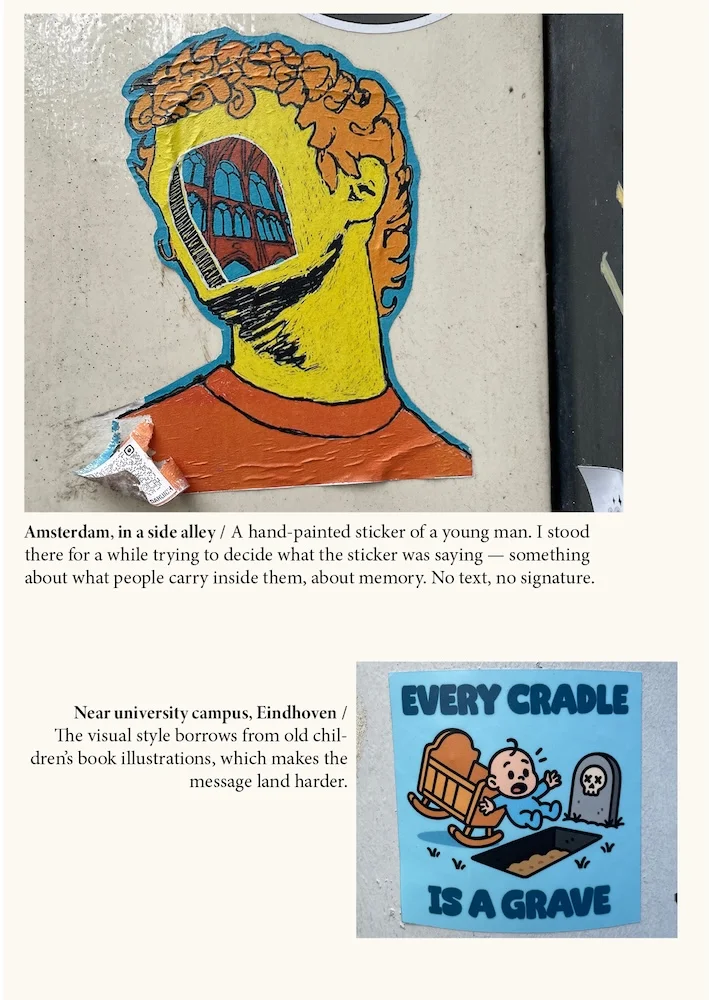
They were funny. Some were sarcastic. Some were strange. A cartoon character I recognised from the books, holding a flag from a war I had read about that morning. A pun in Dutch I could only half-read. A hand-painted face with a cathedral interior drawn where the features should be — no signature, no explanation, just an image left on a wall. Some I understood immediately. Some made no sense to me at all. I started taking pictures of them on my phone. It was easy to photograph them; I did not need my system camera. Just stop, look, click.
Initially, I didn’t think of them as a photography subject. I started capturing them out of curiosity, for their humour and off-beat designs. Over time, though, they helped me connect more closely with social issues and expressions in this new land and culture.

The Murmurs
By early 2025, I realised I had collected thousands of these sticker photographs. I started going through them more carefully and began noticing patterns. The themes were not random. Most stickers clearly reflected the socio-political sentiments of the period.
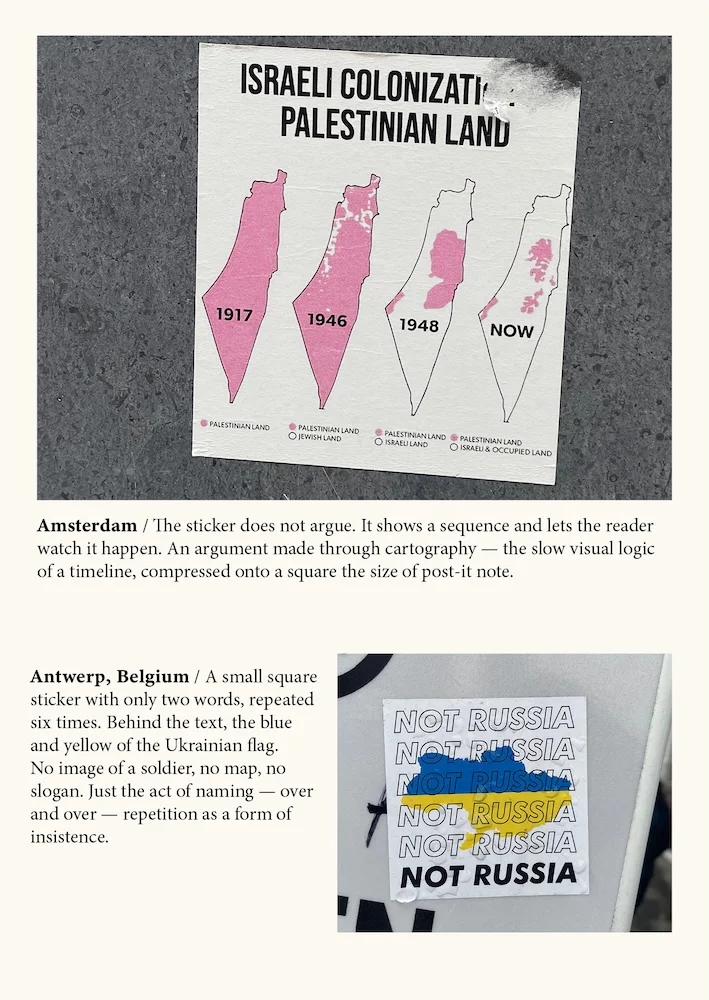
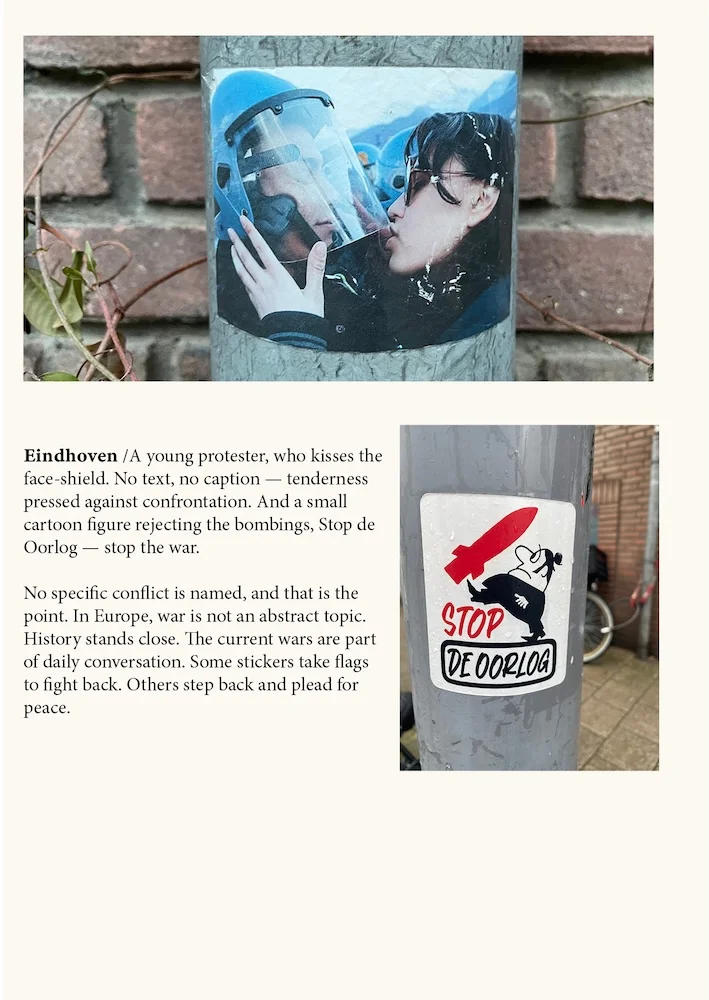
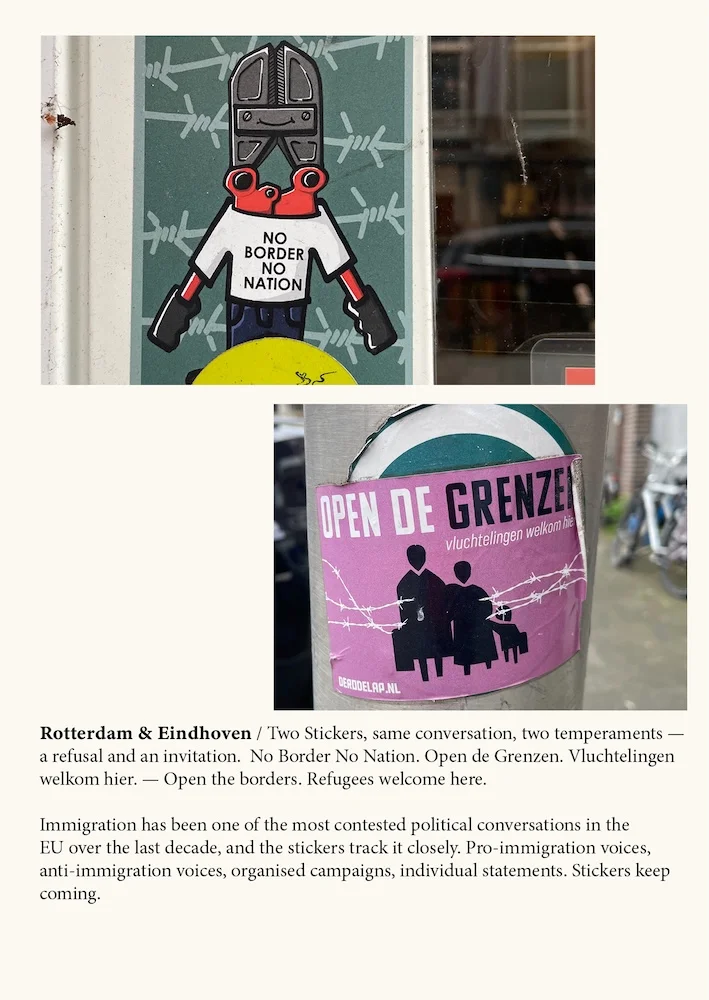
I saw arguments about gender and consent, about the state and surveillance, about race and immigration. I saw anti-fascist stickers responding to events from the week before. I saw the old class anger of ‘Eat the rich’ next to new debates on student debt. A calf looking out from a sticker that said I need my mother’s milk. A football trophy dripping with oil, protesting the Saudi World Cup. A sepia photograph turned into an argument about American exceptionalism. Stickers on global conflicts in Palestine and Ukraine often made their way to the wall during this time. Environmental concerns, animal rights, labour, housing, sport, foreign policy — all of it sharing space on the same lampposts. These were echoes of Dutch, European, and broader global political developments, pulled down to the size of a sticker.
Most of them were unsigned 2×2-inch canvases. No names. No credits.
Individually, they looked like small, independent expressions. But seen together, they felt like a layer of conversation happening in public.
They formed a dispersed but persistent public voice — one without a single author.
Reading into Dutch street art culture, I could understand that within this broader tradition, stickers occupy a unique niche. They are faster to deploy, harder to trace, and intensely personal in scale — yet cumulative in impact.
Voice of a city
Sticker culture is not monolithic. Each city carries its own tone, and over a few years of walking, I began to hear the differences. Though I have photographed stickers in many cities in the Netherlands, a few cities stand out — the ones with a thriving culture of expression, constantly arguing with their inner feelings.
Amsterdam is the one most people outside the Netherlands know: liberal, and full of travellers. Step out of the grand central station and it feels like you are standing in the middle of a world map. Voices and movement everywhere. The walls display climate protest, anti-gentrification arguments, queer politics, and geopolitical commentary, all coexisting next to pure art and humour. I remember seeing a small sticker on a crowded lamppost, titled ‘Buried Beds & Bicycle Frames’. It had fine black-and-white linework showing a bed sinking into canal water, half a bicycle wheel breaking the surface, an old lamppost going under. The entire soul of the city drawn in one tiny sticker — a deeper sense of the things this place has quietly swallowed over time. Here, every surface is already spoken for.
Rotterdam is a port city, Europe’s largest, and one of the most culturally diverse in the country. My wife has a small boutique here, so I visit often. The city was bombed almost flat during the Second World War and rebuilt from the ground up. Though it has healed, the scars of its past still show, hidden within its glass towers and bold modern bridges, unlike any other Dutch town. The absence of historical architecture makes Rotterdam feel like a blank canvas. Walls here are fair game to all. Compared to the old-city restraint of Amsterdam, the sticker scene here is denser, more playful with more experimentation and sharper edges.
Eindhoven, where I live and work, is the country’s design capital, shaped by the long presence of the Philips electronics company, and a strong Design Academy. The city has a younger, more industrial feel than the Dutch cities in the north, with old factories now turned into studios. Here, the walls look different. On a utility box near my street, I once spotted a sticker. A black-and-white figure wrestling with a wind-blown umbrella, and two lines in bold type: ‘BOYCOTT UMBRELLAS / GET WET’. A small joke about the relentless Dutch weather, but displayed like a manifesto. Stickers here are often quieter, more typographic, more conceptual — wit before protest, design sensibility before slogan.
The Hague is where the Dutch parliament sits, and where the International Court of Justice, the International Criminal Court, and many foreign embassies are based. A city with the proximity of world politics. And that changes the tone of the walls. Political parties, activist groups, and international solidarity movements all compete for space. Stickers here feel like the political cartoon of a newspaper. To the point, provocative, but always keeping the debate open. I recall a sticker from here: a portrait of the Syrian president split down the middle,militant on one side, Western suit on the other. A quiet question about his recognition as a legitimate head of state despite his past.
On the lighter side, stickers in all of these cities double as a weapon, used to rally behind the local football team and jeer the visiting opposition.
I have come to think of these cities as meeting points — places where I go to greet a new sticker and listen to its tale. When one sticker goes and a new one takes its place, I listen closely to the murmur.
The sticker photographs that follow are a small walk through what I have been photographing. Most stickers were gone within a few weeks of being photographed, replaced by the next voice on the same pole.
Walk slowly.
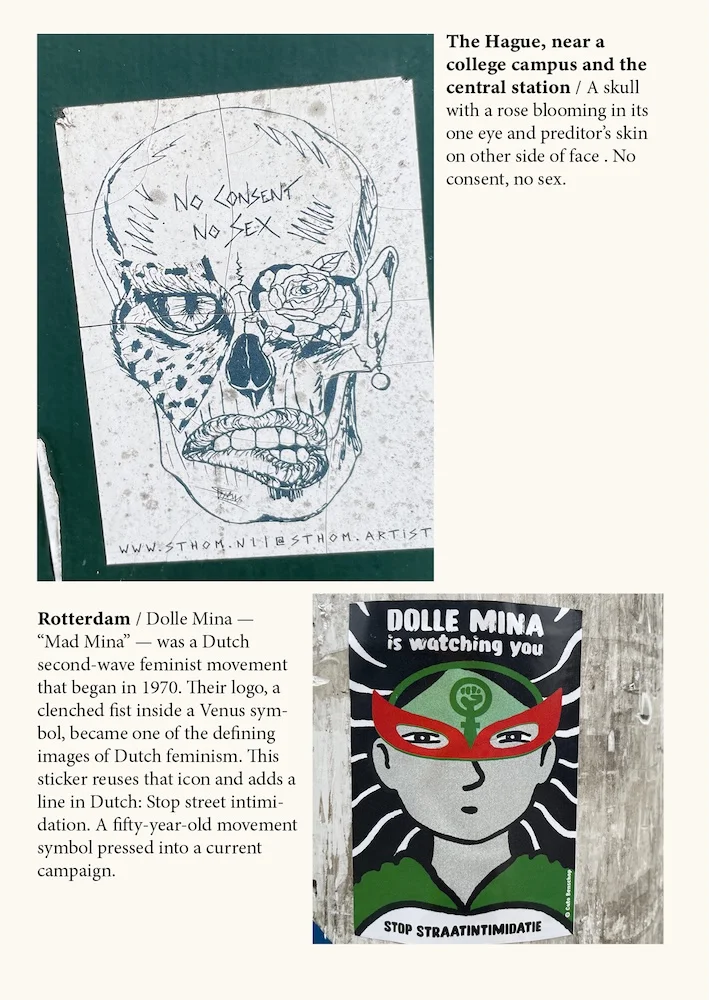
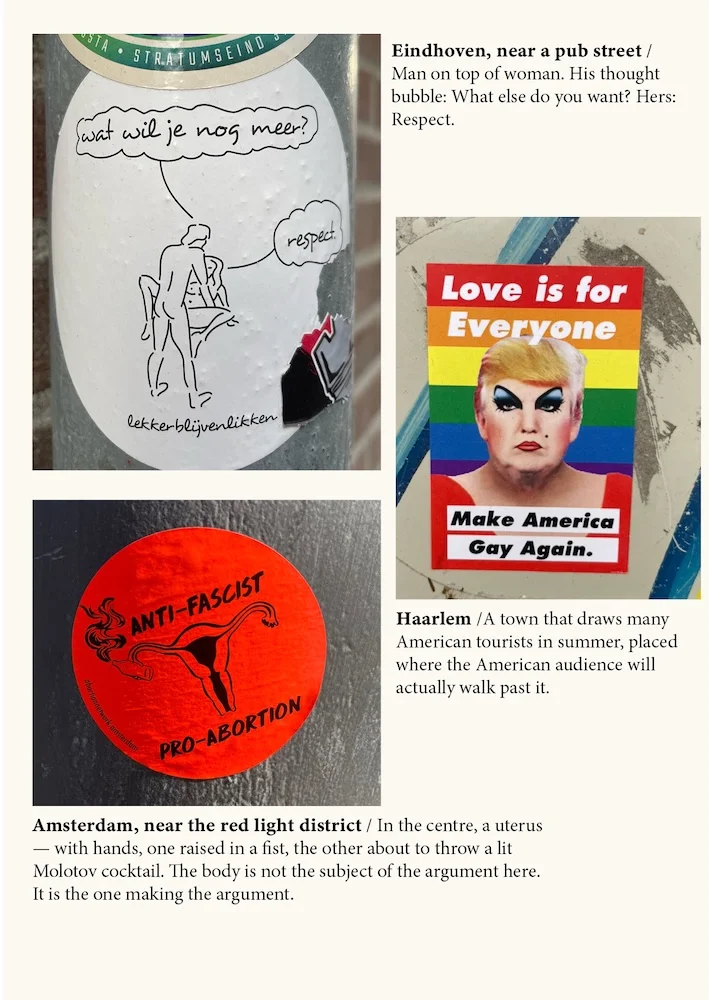
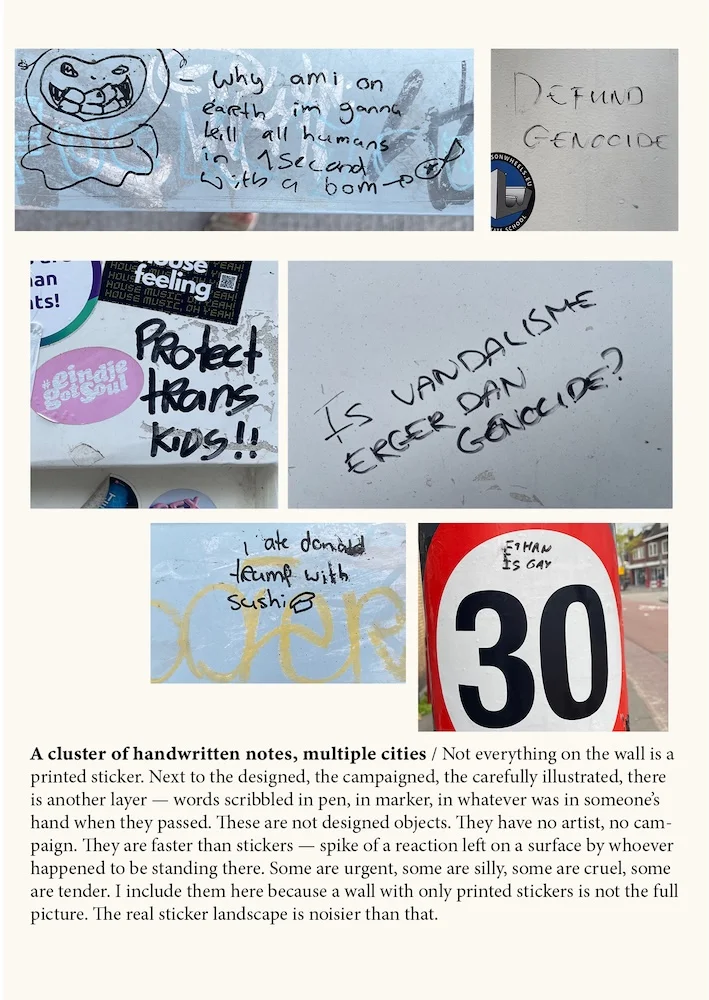
(Selected Sticker photographs, the Netherlands, 2023–2026)
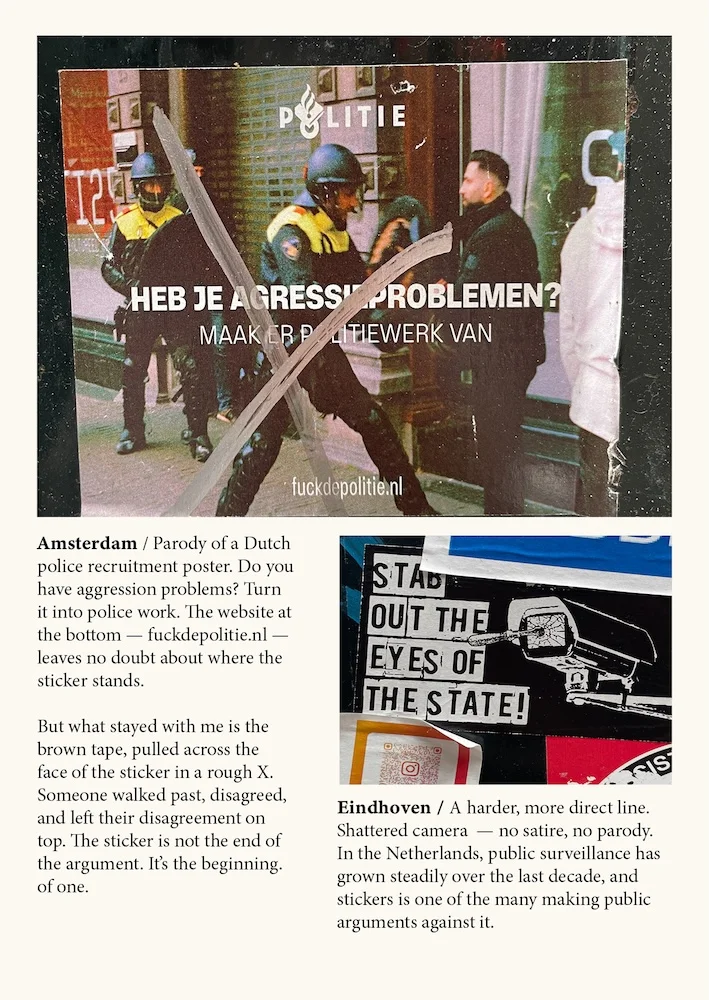
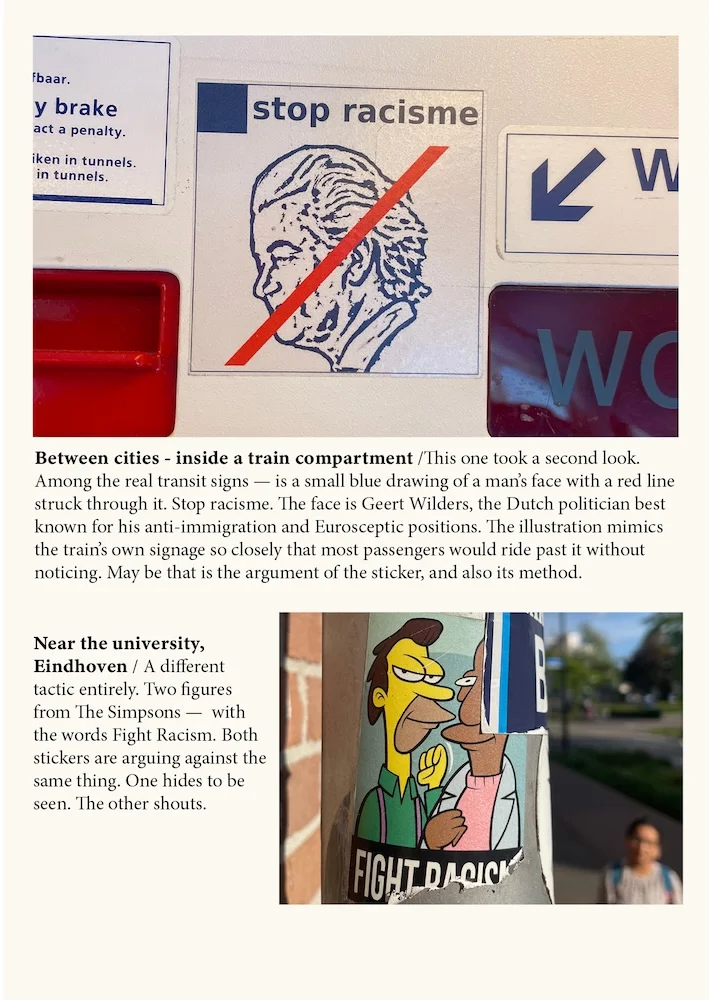
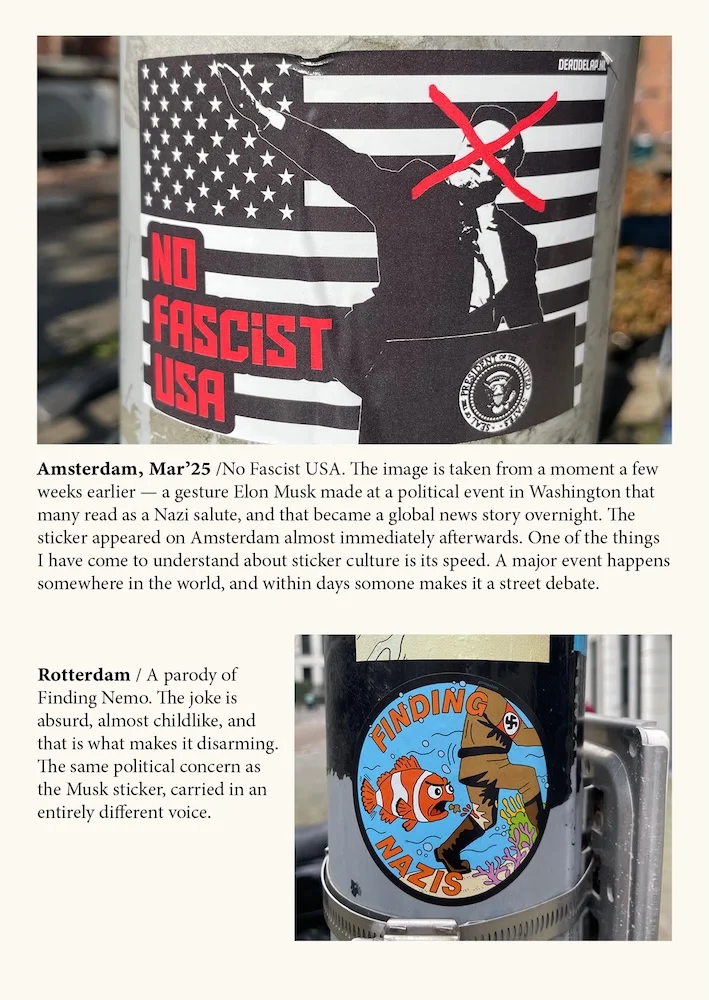
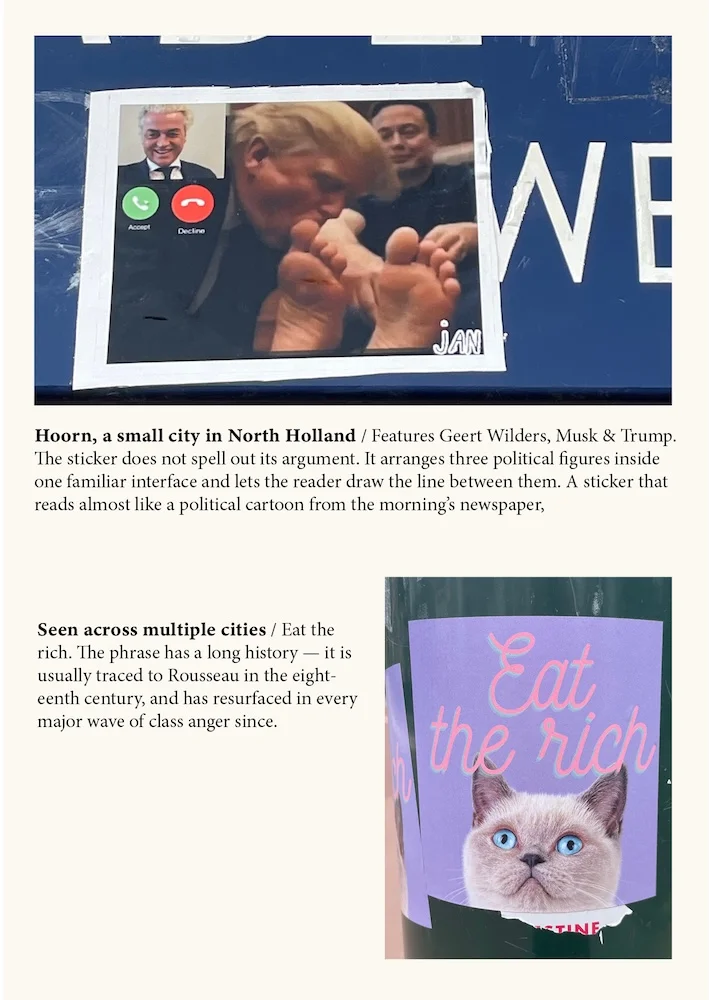
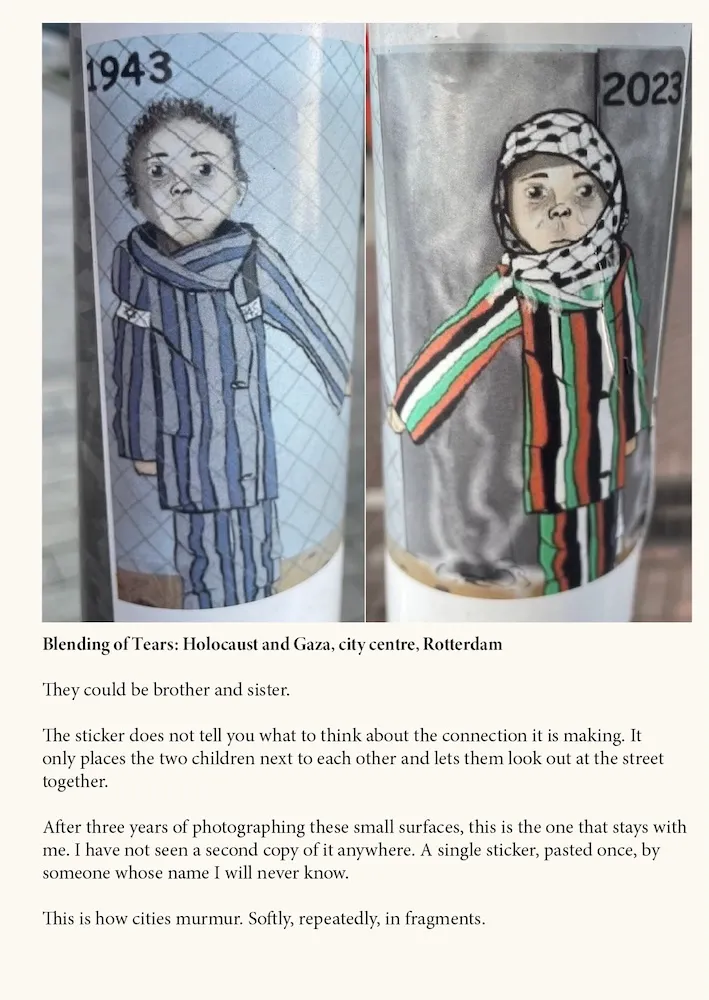
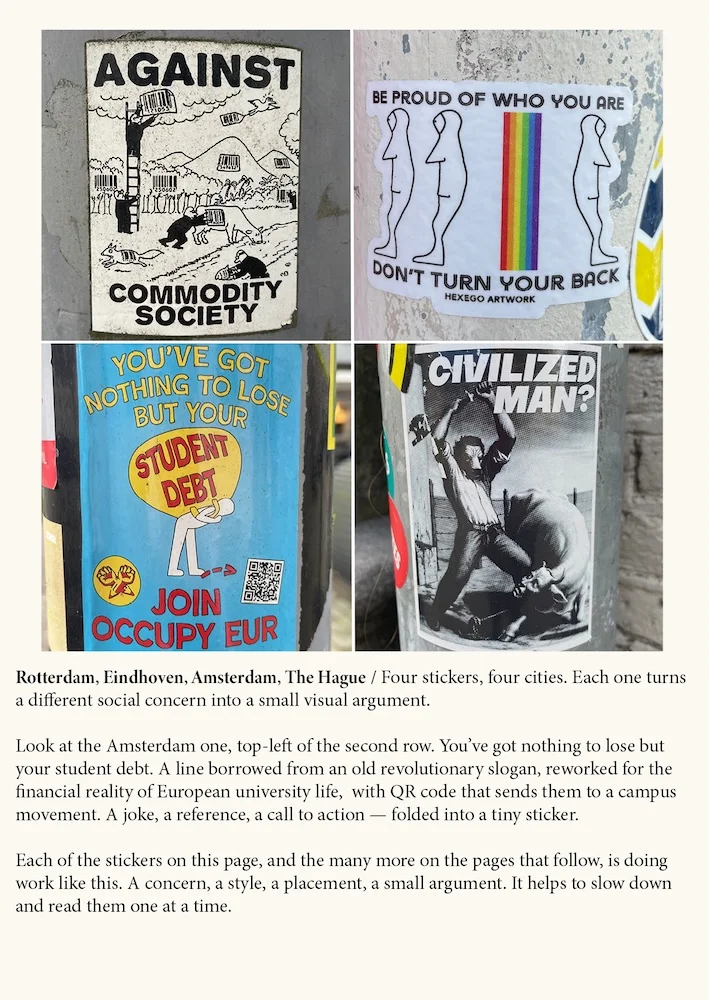
Conversation
I started photographing stickers because they amused me with their distinct style, different from social and print media in the way they celebrate cultural diversity and free expression. Many neighbourhood works reflect the unique history and identity of local residents. Others are more personal, edgier, more confrontational — deeply embedded with subcultural identity markers.
Over time, they became something else. It sometimes feels like I have been listening to many people — young and old, artists, activists, and ordinary passers-by — through these small expressions placed in public spaces.
As an expat living in a new country, observing these stickers has also helped me understand local social undercurrents, how they connect with global issues, what core beliefs and values the society carries, and how the language of expression and protest works. What moved me is the freedom of expression — a space that freely puts forward many conflicting ideas while leaving room for the passerby to take a final call.
Share this:
- Click to share on Facebook (Opens in new window) Facebook
- Click to email a link to a friend (Opens in new window) Email
- Click to share on X (Opens in new window) X
- Click to share on LinkedIn (Opens in new window) LinkedIn
- Click to share on WhatsApp (Opens in new window) WhatsApp
- Click to share on Telegram (Opens in new window) Telegram