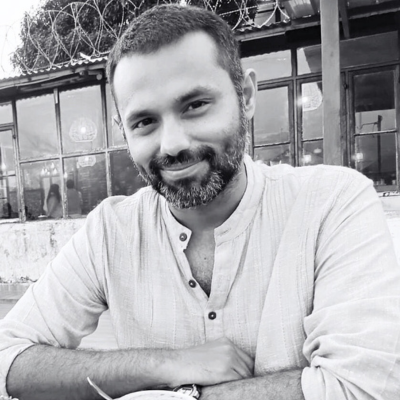
I first came to know of Rohan Chakravarty while casually window shopping for books on environment. I vividly remember how his ‘Pugmarks and Carbon Footprints’ had stood out among other grave titles. As I picked up this collection of comics, I did not have even the slightest inkling that he would not only become one of my favourite artists, but also someone who drastically changed my perspective on comics and their power in bringing about awareness and sensitivity towards animals and their natural habitats.
Rohan had studied dentistry, and had worked as an animator for four years before his chance encounter with a tigress in Nagzira Wildlife Sanctuary led him to give up everything, and start his series of cartoons called Green Humor. In 2013, the series appeared on ‘Gocomics’, becoming the first Indian comic strips to be distributed internationally. Today, Green Humour happens to be the largest collection of cartoons on the internet about wildlife, their natural habitat, its destruction and conservation, and everything in between.
For me, Rohan Chakravarty’s cartoons have been a crucial source of information, humour, and intense but impactful anxiety in equal measures. Being able to talk to him on the layered idea of return was both a privilege and a milestone, something I will always cherish.
Pallavi: Can we begin by returning to your very first cartoon under the Green Humour series? What was it and how did it happen?
Rohan: I actually started on a rather embarrassing note. If I remember correctly, it was back in 2008 when I had just started as a cartoonist. The cartoon was for Miss Sunita Narain, the then chairperson of the Tiger Task Force. She had a very pro-tribal stance in her approach to conservation. My very first cartoon depicted her being kidnapped and tied to a chair by a group of tigers, and getting interrogated by them. Although I laugh when I think about it now, I really regret drawing that piece. Back then Mr. Bittu Sahgal, the founding editor of the Sanctuary Asia actually knew that it was a very uninformed portrayal on conservation and still chose to run it in his magazine, being fully aware it would get him into trouble too. Later, when I had the chance to ask him about it, he told me that this was how he wanted me to learn. I am still very thankful for that. Since then he has been a mentor and father figure for me. I am very glad that I am not that cartoonist anymore!
Pallavi: Animals take centre stage in your works. There is a significant and a satisfying shift in the worldview. We are forced to acknowledge and return to the fact that this world does not exclusively belong to us. Do you consciously draw with this aim?
Rohan: Not really. I think it is something that organically came to me. Before wildlife happened, I was trapped, and was dabbling as a cartoonist trying to find my feet. I have drawn series that have humans as protagonists and got nowhere with them because they were poorly done. It was only after I became seriously interested in wildlife that I found that I am better at drawing animals than drawing people! As I am growing older, I am also becoming a misanthrope even though I try to not project it into my works. Maybe this is why drawing animals comes more naturally to me. I cannot say if I am giving them voice, or using them to express mine. Also, I think a lot of my cartoons, messages, and gags would not be as impactful or effective if they had humans instead of animals. The Green Humour series has not been designed to give animals any agency. I don’t think we as human beings have any authority to give animals any agency or platform.
But I try to portray that this particular creature (whatever animal I am drawing) is far more significant than me or you.
Pallavi: Your works beautifully depict triumphs and complexities of conservation. When you draw these stories, how do you balance the celebration of a species’ return with the grave reality that they are returning to a world far more broken and possibly hostile to them? How do you capture that fragile hope and so successfully mask the inevitable anxiety?
Rohan: I don’t have a particular brief to steer my cartoon in any particular direction. Various occasions, like the impact of some event or news, or even a random sighting during my birdwalk or a nature trail inspires me to draw. I have drawn very simple comics that portray the pleasure of a bird carrying the nesting materials and then there are also more complex works that talk about how the re-discovery of a presumably extinct species would be meaningful to our lives. There are various hidden and interconnected links in trying to understand a particular species and its interaction with nature, and the role it plays in the life of not just an individual but even of a community’s health. Let me give you an example of my hometown Nagpur. Last year there was a massive chikungunya outbreak and there was not a single household in my colony that did not have chikungunya patients, myself included. At that time, there was a lot of criticism about the areas not being cemented and fumigated properly. Unfortunately, the major reason was simply missed not just by the journalists, but also by public health practitioners and politicians. It was the disappearance of dragonflies from our neighbourhood. Dragonflies are the most effective predators for mosquitoes in nature. But most missed this link. You cannot see it unless you have some understanding, and this is what I attempt in my cartoons. Creating this understanding and consciousness is my intention with almost every cartoon that I create.
Pallavi: You don’t shy away from depicting extinctions. What is your emotional and artistic process when you decide to draw an animal that can never return?
Rohan: I’ve never been asked that. These events impact me deeply, and I see the extinction of a species as the failure of humanity. Last year, I was looking at the U.S. Fish and Wildlife Service (USFWS) extinction report and there were as many as 35 animal species that had gone extinct. Unfortunately and shamefully, instead of being breaking news and headlines, these become just footnotes in a newspaper that we don’t even bother reading.
I remember one such case of Bramble Cay melomys, a rodent from Australia’s Great Barrier Reef and the first mammal to go extinct because of human driven climate change in 2016. I came to know of its existence after its extinction made the news. I was ashamed I had not even heard about it. I remember doing that piece on a black canvas and white ink to mourn the fact that you and I will never be able to see these animals ever again.
Pallavi: There is a reasonable idea that we need to return to a more sustainable lifestyle. This often involves a return to indigenous wisdom that has deep knowledge of co-existence. Has it inspired your cartoons?
Rohan Chakravarty for the Arunachal Pradesh Forest Department, 2017
Rohan: So many! A lot of my cartoons explore the clash of indigenous values with that of modern capitalistic values imposed on most urban residents which makes sustainable living very difficult. I had realised very early in my career that to blame an individual for the state of the world today is unfair. What needs to be called out are corporations, larger institutions, and governing bodies. I have portrayed many indigenous cultures, practices and elements. I am very closely associated with the Bugun village council in the West Kameng district of Arunachal Pradesh.
There is a wildlife sanctuary called Eaglenest which houses one of the rarest birds in the world called the Bugun Liocichla, named after the tribe. Recently, the Bugun tribe held a unique ceremony where they assigned official tribal names to two endangered butterfly species. They renamed the Bhutan Glory butterfly as Sharuwa jiing-khonok and the Ludlow’s Bhutan Glory butterfly as Lachhan jiing-khonok. This is a very significant move of restoring the power to the tribes. Fortunately, there are some young forest officers in the region who are making efforts and trying to bring a change. This brings me some hope. I drew a cartoon where the bird Bugun Liocichla is congratulating the endangered butterfly on its new indigenous name.
Pallavi: Your cartoons, with their various animals and their fascinating behaviors, re-enchant the world for us. Are you consciously trying to help your readers (many of whom are children) ignite that childlike curiosity and awe that is so fundamental to the caring of our planet?
Rohan: No. I think they represent my state of mind more than anything. A lot of the work that I put out has been created for me first. When I draw, I do not have a set demographic in mind unless I am commissioned for something. As long as it is within the Green Humour series, an age group is not my target. I operate on the principle that if I am able to understand visually depicted, complex information, most people will also understand it. I consider myself to be an average reader and if something works for me, it will work for most of my readers too. Sometimes, there is complex ecological information and I simply draw comics to understand and retain that information!
Pallavi: Among your works in the Green Humour series, which one would be your favorite? Not just the most popular ones but those that have a special place for you personally and why?
Rohan: I tend to draw a lot of cartoons that are current and political, and I hate those since they tend to get more reactionary and less informative. I personally like apolitical pieces that blend humor and information. I deeply despise drawing humans and politicians. I am also a very harsh critic of my work and usually obsessively nitpick the finer details, constantly trying to improve. One of the cartoons that still makes me chuckle is about the baya weaver bird and its breeding habits. The male baya weaver is a skilled architect who builds very elaborate nests. The female baya weaver bird comes to inspect it and is about to stay when she finds that the toilet seat is up and just leaves. This cartoon was also included in my first compilation called Green Humour for a Greying Planet.
Pallavi: We have talked about the underlying themes and your motive behind Green Humour. I am also curious about your technique. Is there a particular artistic challenge you often return to? Is there a particular aspect you are still trying to improve?
Rohan: Ofcourse! I try to get the eyes right. You know, when you see any animal head on, there is a unique essence that is reflected in its eyes. It is very difficult to describe but that personality and essence is something I strive to capture in my drawings and illustrations. Sometimes I succeed and sometimes I don’t. But this is something I am always after and it is an everyday challenge for me. There are other technical challenges too. I am not too good at drawing elements like cars, aeroplanes, and buildings, and neither do I try to improve. As long as I am able to put the point across, I do not care much about them. But capturing the core identity, personality, and the mischief of such fascinating animals is something I relentlessly strive for. It often evades me but I try my best.
Pallavi: Your cartoons are remarkably effective at simplifying issues. Has there been an ecological tragedy so vast that you struggled to capture it both emotionally and technically?
Rohan: Absolutely yes. This piece was about Gaza. I remember World Water day was approaching and all sorts of events were happening with the U.N. putting out celebratory posts, completely overlooking the fact that the water in Gaza is not drinkable anymore. This was very insensitive and a stark contrast to me. I drew a very reactionary and instantaneous piece. It has a young girl, based on the 5-year old Hind Rajab, who is conducting a test about how drinkable the water in Gaza is. She finds that it is no longer drinkable by any living human, and drinks it herself since she has already been murdered by the Israeli forces. It pained me to create it, but I felt it was necessary.
Pallavi: How do you personally cope with climate grief, burnout and anxiety? How are you able to return with wit and humor with every single comic?
Rohan: I don’t think I can cope with, or even worry about coping with the climate crisis. The climate crisis includes everyday occurrences. For example, it pains me deeply to see the disappearing mongoose from my neighbourhood. I see the rapid concretization of my surroundings, leaving very little space for an animal that used to thrive in its habitat. I try to celebrate that mongoose in my work, and attempt to return that animal into people’s consciousness with the hope that it would lead to some social mindfulness and awareness about them. One of the ways I try to balance is by distancing myself a little from the overwhelming negativity of ecological grief and returning to celebrate and appreciate the beauty of wildlife that I can access. One of my works that tries to do that is Naturalist Ruddy.
It is a very light, silly book where a curious detective mongoose goes about discovering nature, treating his observations like crime scenes. In this way, the reader gets to know intimately about the workings of a mongoose. This work is also something that has kept my hope alive and reminds me that there are still things to explore and be curious about and by extension, there are still things to save.
I am currently having a blast working on the second part of the series.
Pallavi: When people return to your works, or when they discover your cartoons and illustrations, what is one message you want them to imbibe or take away?
Rohan: I will name three things as all are very important to me. First, if you come across an animal, even as small as a spider at home, do not take a newspaper and swat it. My comics will show how a spider in your house prevents fruits from rotting by killing fruit flies. They are your allies and I hope you treat them with respect and dignity.
The second is that many people around me have exotic animals as pets that do not belong in urban habitats. There is a concerned growth among the urban elites to own exotic pets. If my works move or impact you at all, I hope that you never keep an exotic animal as a pet and try to be mindful of the habitat of the pet you get.
Thirdly, and most importantly, when you caste your vote, do it with a strong ecological consciousness.
Featured image credit: Roahan Chakravarty
Share this:
- Click to share on Facebook (Opens in new window) Facebook
- Click to email a link to a friend (Opens in new window) Email
- Click to share on X (Opens in new window) X
- Click to share on LinkedIn (Opens in new window) LinkedIn
- Click to share on WhatsApp (Opens in new window) WhatsApp
- Click to share on Telegram (Opens in new window) Telegram

1 Comment
Rituparna
An intelligent conversation with one of our best cartoonists. Looking forward to the return of Naturalist Ruddy!